Literacy
English
At Oakleigh Primary School we use an evidence-based approach to teaching literacy, based on the science of reading principles.
We teach in an explicit and systematic way to build fundamental concepts and skills.
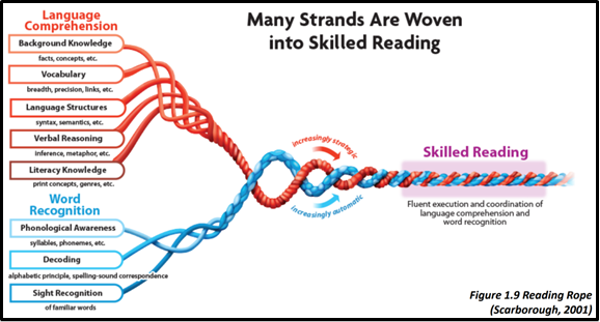
Our approach when teaching reading is reflected in Scarborough’s Reading Rope and summarised into the Big 6:
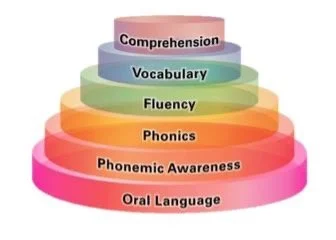
Oral language – knowing and using spoken words to express knowledge, ideas and emotionsPhonemic awareness – the knowledge of sounds (phonemes)
Phonics – knowing the sound (phoneme) and letter (grapheme) relationships
Fluency – reading accurately and at an appropriate rate with expression
Vocabulary – understanding words in isolation and in context
Comprehension – making meaning from text which includes a developing knowledge of grammar.
Our approach to teaching writing is reflected in The Writing Rope
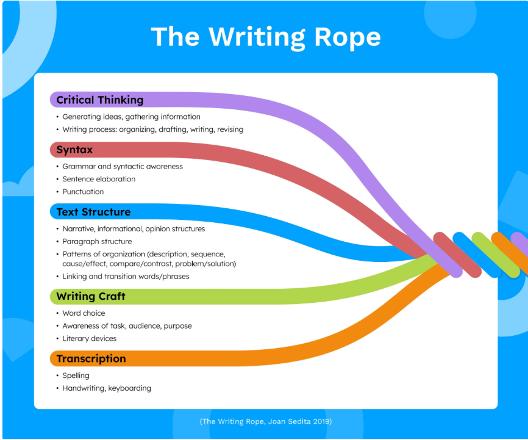
Writing is systematically taught across the year levels. The 6 Writing Traits - Voice, Organisation, Ideas, Conventions, Word Choice, and Sentence Fluency are taught explicitly.
Years F–2
Literacy teaching in Years F–2 establishes the foundational knowledge and skills students need to become confident, fluent and increasingly independent readers and writers. Teaching is explicit, systematic and evidence-informed, with frequent opportunities for students to practise and apply newly taught skills. A daily literacy block begins with activating prior knowledge, handwriting, phonics and word knowledge, regular and irregular high-frequency words, dictation, fluency and meaning-making, as well as supporting students to connect and apply their developing literacy knowledge.
This includes:
Phonological awareness, phonics and word knowledge – daily explicit instruction develops students’ understanding of sounds, phoneme–grapheme relationships, the alphabetic code, spelling patterns and word knowledge. The 25-minute phonics component follows a systematic scope and sequence informed by the Multi-sensory Structured Language (MSL) approach and the Department of Education’s Phonics Plus.
Reading fluency – regular opportunities to develop decoding skills, accuracy and automaticity through repeated reading, modelling and supported practice.
Rich texts and text studies – high-quality texts provide opportunities to develop vocabulary knowledge, comprehension and language skills. The Victorian Lesson Plans are used to support explicit text studies linked to Inquiry topics.
Small group reading – students have regular opportunities to read decodable and other appropriately challenging texts, applying taught skills and strategies as they develop reading stamina, fluency, vocabulary and independence.
Writing – writing is explicitly and systematically developed alongside phonics and word knowledge. Students progress from representing phonemes and writing words to constructing simple, compound and complex sentences and developing connected paragraphs. They are explicitly taught the 6 Traits of Writing to develop ideas, select vocabulary, organise their writing, construct fluent sentences and apply writing conventions.
Years 3-6
Literacy teaching in Years 3–6 builds on the foundational skills developed in the early years, with a continued focus on explicit, systematic and evidence-informed instruction. Students are supported to become increasingly fluent, knowledgeable and independent readers and writers.
This includes:
Phonics, spelling and morphology – explicit teaching continues to strengthen students’ knowledge of phoneme–grapheme relationships, spelling patterns, morphology, etymology and word origins.
Reading fluency – regular opportunities to develop accuracy, automaticity, prosody (rhythm, stress and intonation) and expression through repeated reading, modelling and supported practice.
Independent reading – students read a range of appropriately challenging texts of their choice, using their own ‘good fit’ book to apply taught reading skills and strategies. Sustained reading develops fluency, stamina, vocabulary and reading independence. Teacher conferencing provides opportunities to monitor progress, provide feedback and support individual reading needs.
Novel studies and mentor texts – rich, high-quality texts are used to explicitly teach vocabulary, background knowledge, comprehension strategies, text structures and language. Through discussion, analysis and response, students build knowledge, deepen understanding and develop an appreciation of literature.
Writing – students are explicitly taught to plan, draft, revise and edit writing for a range of purposes and text types. The rich texts explored through novel studies and mentor texts provide models of vocabulary, sentence construction, organisation and text structure, which students draw on to generate and develop ideas and strengthen their own writing. The 6 Traits of Writing are explicitly taught to support students to develop ideas, select precise vocabulary, organise their writing, construct fluent sentences, develop a voice and effectively apply writing conventions.